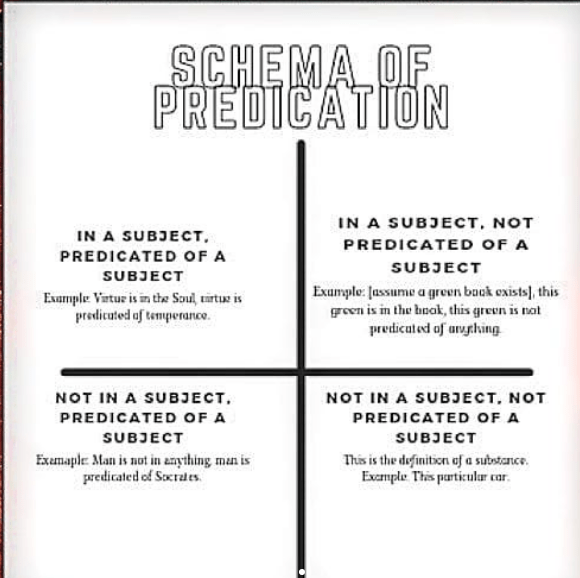
We shall take a brief detour in order to properly examine what it means to state something is in a subject, and to explain what it means to be predicated of a subject. First, we should explain what we mean by subject and predicate. The subject of a statement is what the subject is about. The predicate is what a statement says about the subject. For something to be in something, we mean it has no separate essence removed from the subject. For instance, if we had a green book, the particular greenness would be in the book, although it is not predicated of anything. As stated earlier, a lowest species encompasses multiple subjects. These subjects are particular substances. The species, therefore, is a predicate of the individual subjects.
Moving on, we should now investigate what it means for something to be synonymous or homonymous. First and foremost, you should dispel any notions you have about these terms beforehand. You should also expel the terms “genus” and “species” from your vocabulary as well, as we do not, by these terms, mean the modern biological meaning. When we mention homonyms, we mean, given two different things, have only a name in common, however, the definition of these two terms are separate. For instance, if we have an image of a car, we might refer to this image as a car, however, it is a separate thing from an actual car. When we mention synonyms, we mean that which has both the same name, as well as the same definition. For instance, if we say green is a color, and white is a color, these are both called by a common name (that is, “color”) and the definition of being is also the same.
 Mind and Essence
Leave a comment